

“The good news is that water is no longer a primary resource constraint for building data center IT infrastructure. But increasing efficiency in water use is leading to higher electricity demand. And electricity remains the main resource constraint on data centers.”
Summary
New data centers are about 10 times more water efficient than the older ones with evaporative cooling systems.
The more modern water-efficient closed-loop cooling technology is less energy efficient than the older evaporative cooling technology. But that inefficiency is diminishing.
Data and trends suggest that computational electrical efficiency will rise 3x between 2027 and 2030. This means the energy per computational output will decline by 88% between 2027 and 2030.
Introduction
This year has seen a surge of national polling on data centers, and the results are strikingly consistent. Americans are increasingly skeptical of rapid data-center development and are especially hostile to having one built near them.1 In both the Gallup poll (see Jones, 2026) and the CBS News/YouGov poll (see De Pinto, 2026), the two most common reasons for opposing data centers were their use of water and electricity. Yet the CBS News/YouGov survey showed that only 16% of respondents said they knew “a lot” about data centers.
In this article, I dispel some of the misinformation and myths about data center water use and highlight how modern cooling technology has vastly reduced water use. I also highlight the connection between data center water use, increased energy demands, and the parallel increases in energy efficiency in modern data center designs.
By showing that water resource constraints are no longer a major issue with data center construction, this article shines a light on the remaining fact that electrical resource constraints are the primary resource constraint for data centers. Despite the increases in data center electrical efficiency, states and countries need to figure out how to provide more power for these critical components of the US IT infrastructure.
This article is organized into the following four sections, followed by a concluding section, references, and two appendices.
Water use per kWh is falling sharply in the best new designs
What is new about modern closed-loop cooling
There is still a water-energy tradeoff
Energy per unit of compute is falling extremely rapidly
1. Water use per kWh is falling sharply in the best new designs
“For a new facility, the trends in the evidence suggest the current technological frontier for data center water efficiency is 0.1 - 0.3 L/kWh. That is about 10 times more water efficient than the older traditional evaporative cooling systems.”
The standard metric for data center water use is Water Use Effectiveness (WUE). It measures the liters of water per amount of energy delivered over some period.
Historically, a data center using cooling towers or direct evaporative cooling could consume roughly 1.7–2.5 L/kWh, depending heavily on climate, cycles of concentration, equipment, and operating practices.2 The trajectory of water efficiency (WUE) at the leading hyperscalers is dramatically lower. Table 1 shows that the frontier closed-loop cooling technologies on new data centers are about 10 times more water efficient than the older traditional evaporative cooling technologies.
Microsoft reports that its fleet-wide WUE fell nearly 90%, from about 2.3 L/kWh to 0.27 L/kWh in 2025.3 AWS reports 0.12 L/kWh in 2025, down from roughly 0.25 in 2021, although one needs to be careful because companies sometimes report withdrawal WUE and sometimes consumptive WUE.4
And those fleet averages actually understate what is occurring in new construction. In Priest and Solomon (2026), Microsoft says its newest liquid-cooled AI data centers use direct-to-chip closed loops with zero water evaporation. Oracle says the same about AI facilities it is building in New Mexico, Michigan, Texas and Wisconsin. The cooling system is initially filled and subsequently has essentially no evaporation, blowdown, or continuous makeup-water requirement.5
For a new facility, the trends in the evidence suggest the current technological frontier for data center water efficiency is 0.1 - 0.3 L/kWh, which is about 10 times more water efficient than the older traditional evaporative cooling systems. For modern data centers, water usage is no longer the main resource constraint.
As a caveat, there is no guarantee that every facility is moving this way. For example, Australia’s NextDC data center firm just reported a deterioration in water use effectiveness from 2.25 to 2.40 L/kWh, illustrating how much actual outcomes depend upon cooling architecture, climate, commissioning and operation.6
A June 2025 study from Lawrence Berkeley National Laboratory researchers makes the point that water consumption per kWh varies by more than three orders of magnitude across configurations, and total workload water use varies by more than 10,000 times.7 Cooling architecture, grid generation, server efficiency, utilization and climate all matter.
2. What is new about modern closed-loop cooling
The phrase “closed-loop” can be misleading because chilled-water systems have already been closed loops for decades. The important recent advances in data center cooling technologies are a combination of the following components:
Direct-to-chip liquid cooling
Warmer coolants
High-efficiency heat exchangers
Dry outdoor heat rejection
The first row of Figure 1 shows the traditional evaporative cooling technology workflow. The second row of Figure 1 shows the new closed-loop data center cooling technology workflow that is increasingly implemented in new data centers.
Figure 1. Traditional evaporative cooling workflow versus modern closed-loop cooling workflow
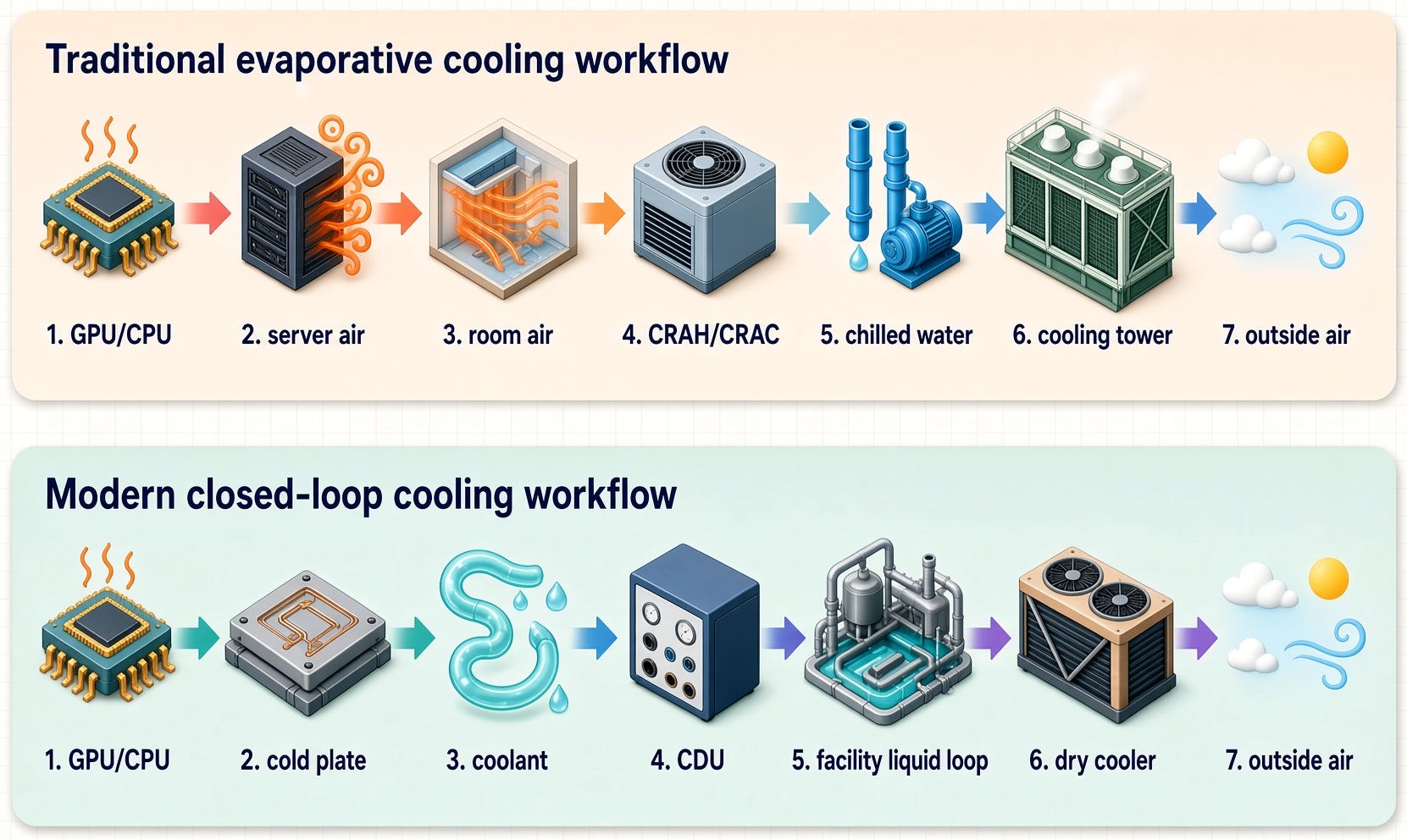
In the modern closed-loop cooling workflow in the bottom panel of Figure 1, the coolant is brought directly next to the processors (CPU/GPU), functions as a coolant at higher (less cold) temperatures, and never has to evaporate.
Grizzel (2026), an Oracle cloud infrastructure architect, gives a good analogy. The modern closed-loop cooling system is basically a large-scale automobile radiator. Coolant picks up heat at the chip, carries the heat outside, rejects the heat through a radiator-like heat exchanger, and returns to the chip.
Five key engineering advances make the modern closed-loop cooling workflow possible.
Better cold plates (stage 2 in the modern closed-loop cooling workflow). Microchannels and optimized flow geometry put the coolant within millimeters of the GPU or CPU die. Water has roughly 4 times the heat capacity of air by mass and vastly greater volumetric heat-carrying capability. Instead of blowing enormous quantities of air across a 1,000 – 1,400 W GPU, heat is captured by the more efficient water or liquid coolant at its source.
Coolant distribution unit (CDU, stage 4 in the modern closed-loop cooling workflow). The server loop is separated hydraulically from the facility loop through a heat exchanger. The CDU controls pressure, flow, temperature, filtration and leak detection. That isolation allows highly controlled coolant conditions around extremely expensive electronics without requiring the entire building’s water circuit to have the same chemistry or pressure.
Higher coolant temperatures. If the water returning from the rack is already 40–50°C, you often don’t need a conventional refrigeration cycle to dump its heat into 20–35°C outdoor air. The temperature difference itself can do much of the work. This enables chiller-less or nearly chiller-less operation.8
Increased use of microchannel heat exchangers. This engineering gives a large surface area and small thermal resistance while reducing coolant volume and fan requirements.9
Improved software. Thousands of sensors now dynamically adjust pumps, fans, flow rates and temperatures. Instead of designing the entire facility around the worst conceivable summer afternoon and running it that way year-round, the cooling system continually adjusts toward its optimal operating calibration. Evans and Gao (2016) show how Google DeepMind’s work on machine-learning control of data center cooling reduced their data center cooling bill by 40%.
3. There is still a water-energy tradeoff
While it is true that modern data center closed-loop cooling architecture is more water efficient, this more modern approach requires more electricity than the traditional evaporative cooling technology. And the water-energy tradeoff can become more electrically expensive in areas like Phoenix, Las Vegas, or Texas with hot average temperatures.10
The newer direct-liquid designs are narrowing that tradeoff substantially because they deliver heat to the outdoor heat exchanger at much higher temperatures. This means that data centers constructed in 2027-2030 are likely to have the newer direct-liquid designs with their low water use (low WUE), with a smaller and narrowing energy use penalty (lower power usage effectiveness, PUE).
One last caveat to the water efficiency discussion around data centers is that they include both direct water usage efficiency measures or site WUE, and they also include indirect water usage called source or lifecycle water intensity. Examples of indirect water usage and intensity are data centers that use a gas combined-cycle electricity plant, nuclear plant or steam-cycle thermal electricity generator. These power sources that might power a data center also use water, which indirect usage is incorporated into the source or lifecycle water intensity measure but is not incorporated into the site WUE measure.
4. Energy per unit of compute is falling extremely rapidly
“AMD reached an estimated 4 times increase in AI energy efficiency from 2024 to 2026, building momentum toward its 2030 goal to deliver a 20 times increase in rack-scale efficiency for AI training and inference.” (AMD, 2026)
“…it is not unreasonable to project a 3x increase in computational efficiency between 2027 and 2030. The trends and predictions… suggest that the watts/FLOPS or energy per computational output could be reduced by 88% between now and 2030.”
Water is no longer a major constraint on data center construction. Instead, electricity remains the main resource constraint. Although the more water-efficient modern closed-loop data center cooling systems actually use more electricity than the older evaporative systems, this increased electrical penalty is also declining as the technology improves. In addition to improvements in water cooling systems’ electrical efficiency, data centers’ computational electrical efficiency is improving extremely rapidly.
A current measure of computational intensity in the generative AI and large language model (LLM) context is the token. Each prompt that a user submits to an LLM is broken down into basic units, like words, that are called tokens. The number of tokens initiates computations using the model in order to return a response from the LLM. A more objective unit of computational intensity is the floating point operation or FLOP, which is one arithmetic operation in a computer system performed on numbers represented in floating-point format.11
A measure of the electrical efficiency of data center computational intensity must measure the number of FLOPs per amount of electricity per unit of time. A joule is a unit of energy that is measured in watts (units of electricity) times seconds (units of time). And FLOPS represents floating point operations per second or FLOPs/sec. So equivalent measures of data center electrical efficiency of compute could be the following, in which more compute electrical efficiency is characterized by higher FLOPs per watt second or higher FLOPS per watt.
For example, an AMD MI300X high performance computing data center GPU accelerator chip provides about 3.48 × 10¹² FLOPS/watt. This would represent one of the highest efficiency compute per watt chips on the market. This chip is likely one of the two unlabeled pink dots in the upper-right corner of Figure 2.
Epoch AI’s 2026 “Trends in Artificial Intelligence” reported that the FLOPS per watt compute efficiency is increasing at a rate of 34% per year for leading hardware since 2016. Figure 2 is a screenshot of the GPU electrical efficiency plot from Epoch AI (2026). The pink dots show that leading GPU hardware from 2016 to 2024 and each hardware’s release data and FLOPS per watt. The pink dashed line represents the estimated growth rate per year. An equivalent statement is that the watts per FLOPS (floating point operations per second) are decreasing at a rate of 34% per year.
Figure 2. Machine learning hardware by release date and compute performance per watt (FLOPS/watt), from Epoch AI (2026)
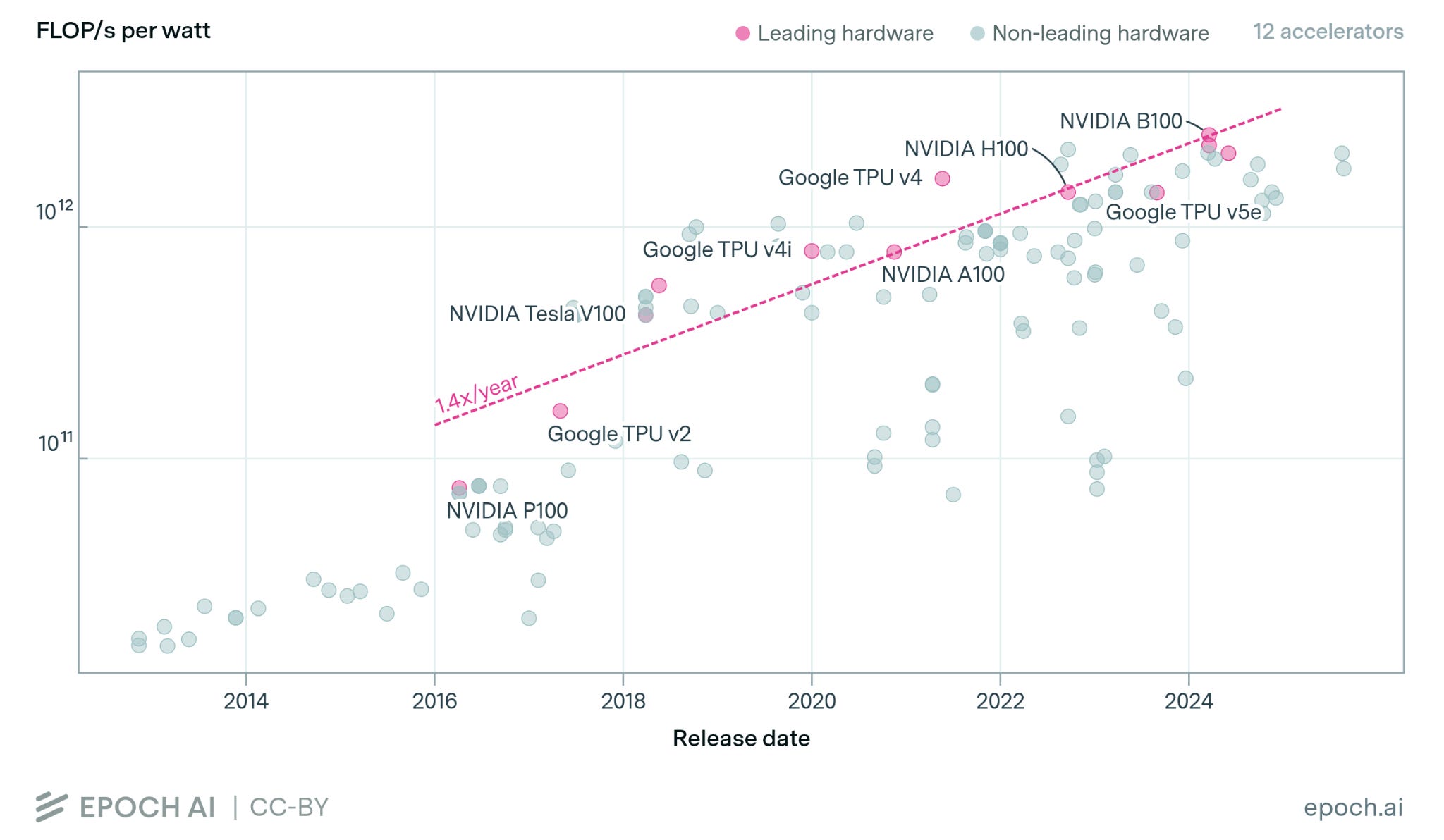
Epoch AI’s (2026) estimate of 34% annual increase in FLOPS/watt or 34% annual decrease in watts/FLOPS suggests that computational efficiency per unit of energy will more than double by 2030 (1.344 - 1 = 2.22 or +222%). This efficiency is augmented by the potential move to lower numerical precision.12
AMD (2026) presented its new efficiency roadmap, which is striking and ambitious. “AMD reached an estimated 4 times increase in AI energy efficiency from 2024 to 2026, building momentum toward its 2030 goal to deliver a 20 times increase in rack-scale efficiency for AI training and inference.” This implies a 4.7 times increase in computational efficiency between 2027 and 2030. As AMD reports, this is considerably faster than historical semiconductor trends. Figure 3 is the first figure in the AMD (2026) report, and shows their 2024-2026 FLOPS/watt growth and their projected efficiency increases through 2030 against the lower historical industry average efficiency growth.
Figure 3. AMD (2026) projected electrical efficiency growth (FLOPS/watt) compared to industry average
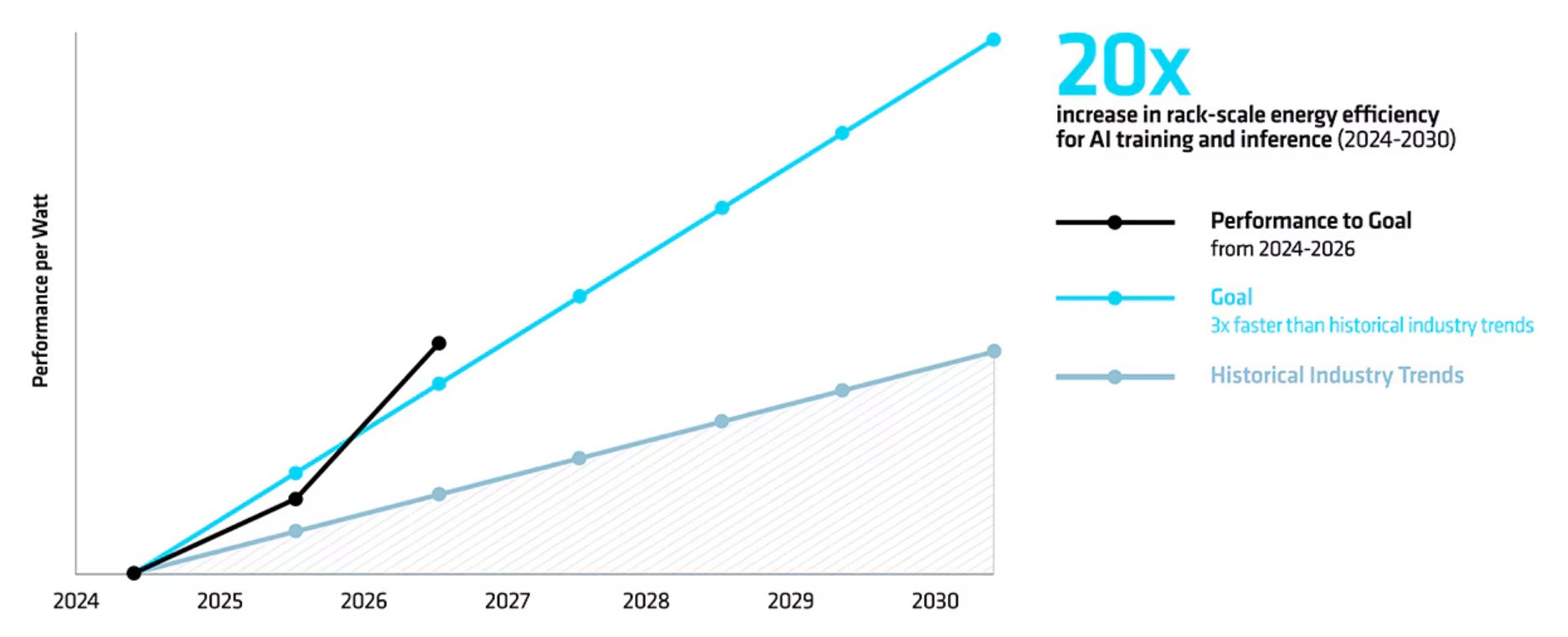
Between AMD’s projected goal of 4.7 times computational efficiency increase from 2027 to 2030 and Epoch AI’s historical estimate of 34% per year increase or 2.2 times increase between 2027 and 2030, it is not unreasonable to project a 3x increase in computational efficiency between 2027 and 2030. The trends and predictions of AMD (2026) and Epoch AI (2026) suggest that the watts/FLOPS or energy per computational output could be reduced by 88% between now and 2030.
Conclusion
The good news is that, given recent trends in data center cooling technologies, water is no longer a primary resource constraint for building data center IT infrastructure. But increasing efficiency in water use is leading to higher electricity demand. And electricity remains currently the main resource constraint on data centers.
The bad news is that current US data center capacity is nowhere near the demand for computational capacity from all sources of the world’s broad IT providers. This means that demand for electrical capacity will continue to increase despite the increases in electrical efficiency in computation and in cooling systems.
With the water resource constraint seemingly solved, the electrical resource constraint becomes paramount. States and countries that add electrical capacity the fastest will grow the fastest.
References
AMD, “AMD Tracks Ahead of Rack-Scale AI Energy-Efficiency Goal,” Advanced Micro Devices (Aug. 18, 2026).
APPC, “Opposition to Local Data Centers Rises Sharply, Annenberg Survey Finds,” Annenberg Public Policy Center, University of Pennsylvania (Aug. 11, 2026).
ASHRAE, “Integrated Design Principles: AI Data Center Energy Performance Framework,” American Society of Heating, Refrigerating and Air-Conditioning Engineers (2026).
Davies, Alex, “Amazon’s data centers are 7x more water-efficient than the industry average. Here’s how we do it.” Amazon News (Jun. 11, 2026).
De Pinto, Jennifer, “More oppose than favor data centers in their area, but few admit knowing a lot about them, CBS News poll finds,” CBS News (Jun. 24, 2026).
Epoch AI, “Trends in Artificial Intelligence,” Epoch AI (Updated Feb. 5, 2026, accessed Sep. 2, 2026).
Evans, Richard and Jim Gao, “DeepMind AI Reduces Google Data Centre Cooling Bill by 40%,” Blog, Google DeepMind (Jul. 20, 2016).
Grizzel, Travis, “Closed-loop cooling in Oracle AI data centers,” Blog, Oracle (Feb. 9, 2026).
Ipsos, “AI data centers are unpopular with most Americans,” Ipsos (May 8, 2026).
Jones, Jeffrey M., “Americans Oppose AI Data Centers in Their Area,” News, Gallup (May 13, 2026).
Katakam, Vishnu Sree Shanthanu, Mariam Arzumanyan, Ning Lin, and Vaibhav Bahadur, “System-scale design and analysis of desalination systems for meeting water needs of data centers,” Water Research (2026, available online, forthcoming).
Kaye, Byron, “Australia data centre firm NextDC reports rising water, energy use with profit beat,” Reuters (Aug. 27, 2026).
Lei, Nuoa, Jun Lu, Arman Shehabi, and Eric Manaset, “The water use of data center workloads: A review and assessment of key determinants,” Resources, Conservation and Recycling, 219:1 (Jun. 2025).
Meyer, Robinson, “Exclusive: 75% of Americans Now Oppose Local Data Center Development,” Daily briefing, Heatmap (Aug. 19, 2026).
NVIDIA, “GEMM Speedups Across Precision,” Transformer Engine documentation, NVIDIA (accessed Sep. 2, 2026).
Palyekar, Ananya, “ByteDance targets mega AI model that could match Mythos scale FT reports,” Reuters (Aug. 6, 2026).
Patel, Dylan and Gerald Wong, “GPT-4 Architecture, Infrastructure, Training Dataset, Costs, Vision, MoE,” Semianalysis (Jul. 10, 2023).
Priest, Judy and Steve Solomon, “Inside Microsoft’s two-decade push to cut water intensity while scaling for growth,” Official Microsoft Blog, Microsoft (Jun. 24, 2026).
Sevilla, Jaime, Tamay Besiroglu, Ben Cottier, Josh You, Edu Roldán, Pablo Villalobos, and Ege Erdil, “Can AI scaling continue through 2030?” Epoch AI (Aug. 20, 2024).
Talib, Rand and Jay Dietrich, “Dry cooling energy performance can rival evaporative cooling,” Briefing report, Uptime Institute (Apr. 24, 2026).
Tano, Ines-Noelly, Erfan Rasouli, and Vinod Narayanan, “Thermal Design and Performance Modeling of a High Compute Density Liquid Cooled Chiller Less Modular Edge Data Center,” Journal of Electronic Packaging, The American Society of Mechanical Engineers, 148:2 (Jun. 2026).
Vertiv, “Vertiv CoolChip CDU: Coolant distribution units for high-density deployments,” Product brochure, Vertiv (2026).
Volcovici, Valerie and Jason Lange, “Americans wary of AI-driven data center boom, Reuters/Ipsos poll shows,” Reuters (Jun. 11, 2026).
Appendix: 2026 US data center opinion polls
In this appendix, I highlight six large scale opinion polls from 2026 that focused on US citizen attitudes regarding data centers. Table 2 summarizes these polls.
Appendix: Tokens and FLOPs as measures of computational intensity
In an AI and large language model (LLM) setting, a token represents a basic unit of text that an LLM processes. For example, a prompt given to an AI model asking, “What is a data center?” would likely be six tokens: “What”, “is”, “a”, “data”, “center”, “?”. These tokens are the inputs into an LLM, and then the LLM processes those tokens through its trained model with N parameters in order to generate an answer. This process of taking tokens as inputs and using a trained LLM to create a response is called inference.
One disadvantage of using tokens as a measure of computational intensity is that the amount of work the computational system must do to process a given number of tokens depends on the size of the underlying LLM in terms of the number of its model parameters N.
Take as an example Meta’s Llama 3.3 70B model with approximately 70 billion parameters (N=7.0 × 10¹⁰).13 For this model, the floating point operations per token for inference using the model would be about 1.4 × 10¹¹ FLOPs/token (2 × 7.0 x 1010 = 1.4 × 10¹¹). But it is estimated that Anthropic’s Fable 5 model has around 5 trillion parameters (1.0 × 10¹³ FLOPs/token) and OpenAI’s GPT-4 has about 1.8 trillion total parameters (3.6 × 10¹² FLOPs/token).14
Because the computational intensity of performing inference on a token varies by more than two orders of magnitude based on model characteristics, a more objective unit of computational intensity is the floating point operation or FLOP. A FLOP is one arithmetic operation performed on numbers represented in floating-point format. Floating point numbers are essentially the computer equivalent of scientific notation (e.g., 1.7539 × 10¹²). There exist many computational operations that are not FLOPs, but the FLOP is a great metric of computational intensity in AI and high performance computing because most of these computational processes are represented by FLOPs.
Examples of computational processes that are not FLOPs include the following:
Integer arithmetic: addition, multiplication, division on integers
Logical operations: AND, OR, XOR, NOT
Comparisons: greater than, equal to, etc.
Memory operations: loading data from memory and storing results
Data movement: moving information among registers, cache, RAM, GPUs, or machines
Branching/control flow: deciding which instruction to execute next
Communication: transferring data between GPUs or nodes
Specialized operations: encryption, compression, tensor operations, database lookups
FLOPs are an excellent common metric for compute-intensive numerical workloads, including AI and traditional scientific high performance computing (HPC), but they are not a universal unit of computation. For forecasting data-center electricity demand, joules per useful FLOP is useful but incomplete because memory movement, networking, utilization, and other non-FLOP work can be increasingly important.
As I describe in Section 4, both Epoch AI (2026) and NVIDIA (2026) are projecting growth in computational efficiency between 2.2-4.7 times between 2027 and 2030. Importantly, these increases in computational efficiency are not coming from transistor scaling alone. The efficiency improvements also come from the following areas of innovation:
Lower-precision arithmetic
Chiplets and packaging
Much higher-bandwidth memory
Moving less data
Better GPU interconnects
Specialized matrix hardware
Higher utilization
Rack-level power optimization
Software/compiler improvements
Co-designing models around the hardware
See Table 3 in “Appendix: 2026 US data center opinion polls”. Sources for these polls are Jones (2026), Ipsos (2026), Volcovici and Lange (2026), De Pinto (2026), APPC (2026), and Meyer (2026).
See Katakam, et al (2026).
See Priest and Solomon (2026).
See Davies (2026).
See Grizzel (2026).
See Kaye (2026).
See Lei, et al (2025).
Tano, et al (2026) test the cooling workflow direct-to-chip cold plates → a single liquid loop → microchannel dry cooler → ambient air. At 40°C outdoor temperature, cooling electricity could be only 2.1% of compute power, and optimized configurations fell below 1%. That is remarkably close to thermodynamically “free” cooling compared with older refrigeration systems. See also summary here.
See Tano, et al (2026).
See Talib and Dietrich (2026).
See “Appendix: Tokens and FLOPs as measures of computational intensity”.
Sevilla, et al (2024) estimated that the move to FP8 (8-bit precision) training from the current FP16 (16-bit precision) training will give an approximate 2 times increase in power efficiency. But current frontier model training is happening at mixed precision across FP32, FP16, and FP8. See NVIDIA (2016). So this 2 times estimate from Sevilla, et al (2024) is likely an upper bound. On the other hand, AMD (2026) reported they had a 4 times increase in computational efficiency from 2024 to 2026. And their goal for 2030 is 20 times increase in rack-scale efficiency.
Meta’s Llama 3.3 70B model is open source and available through the Hugging Face web platform at https://huggingface.co/meta-llama/Llama-3.3-70B-Instruct.
See Palyekar (2026) for the estimate that Anthropic’s Fable 5 has approximately 5 trillion parameters. And see Patel and Wong (2023) for the estimate that OpenAI’s GPT-4 has 1.8 trillion parameters.